Saturday, May 31, 2014

MAKING THAT FIRST CONTACT

I had the opportunity to chat with CL Gammon about "Begotten With Love" on his blog talk radio program this morning. If you'd like to listen to the half hour show just click on the following link:  CL Gammon Program. CL is very charming and made me feel comfortable throughout the interview. Thank you CL for a fun half hour.

One of the questions he asked: ". . . were family members receptive?"  My experience has always been very positive. I treasure my newly found cousins and am grateful for all they've shared. It's been fun to discover personal traits we share; enjoy a poignant moment walking the path of our shared ancestors; and visiting old homesteads and cemeteries together.

If you've not yet contacted anyone my suggestions would be:

  • Write a note explaining who you are and how you think you may be related (you'll be surprised how often you may receive a response) especially if you include a picture they may recognize.
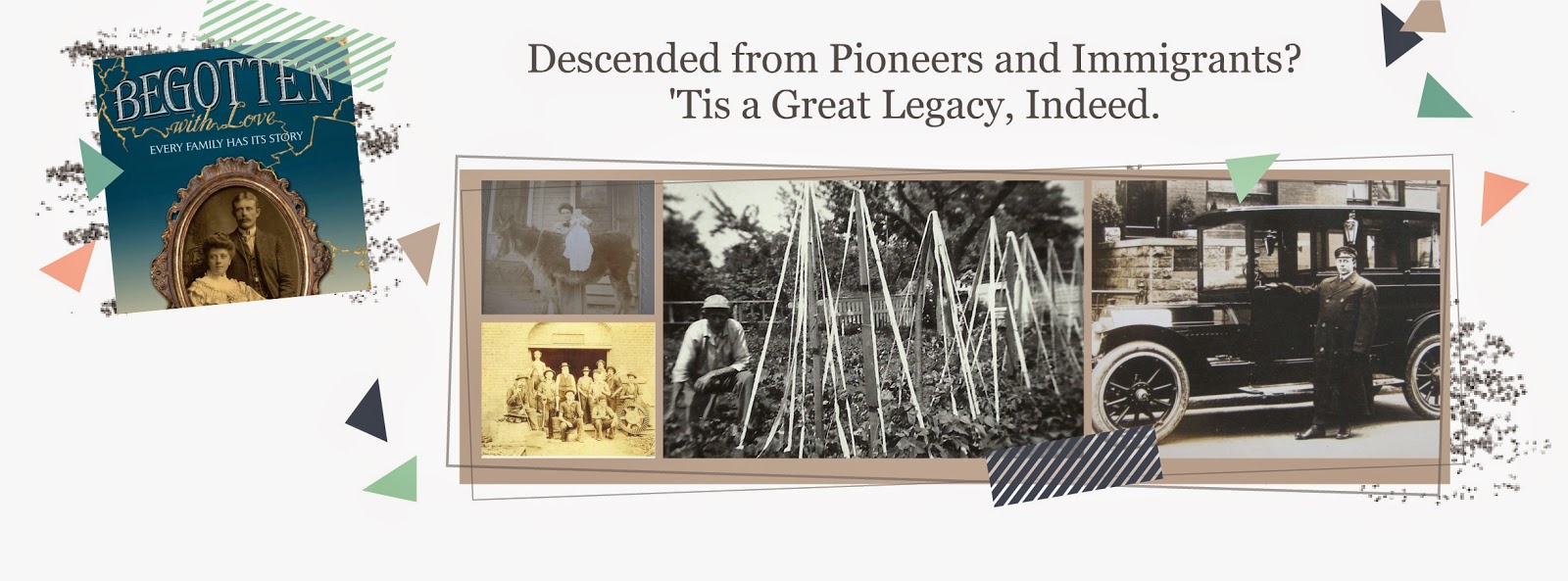
  • Share a story about your side of the family . . . one they may have heard and see if they may embellish it. You know how stories have a tendency to grow. My cousin could start a round of laughter when he talked about his donkey, Blue Creek Bill.
  • Grandma's recipe box may open doors (and mouths) especially if you bake a batch of her favorite cookies to share.
It seems the kitchen table is still the heart of the home and the point of connecting with family is to build on relationships. Happy hunting. 

Jo Ann V. Glim is a 40 year veteran of  freelance writing and author of the eBook "Begotten With Love." To learn more:

FOLLOW/Like: on Facebook or

VISIT: www.BEGOTTENtheBook.com or
BUY ON: Amazon.com/author/joannglim

Friday, May 9, 2014

FINDING CLUES to the PAST

GENEALOGY    Part IV


Some men and women risked it all for the romance of a high-seas adventure. Steamship companies circulated pamphlets promising riches in the land where "streets were paved with gold." It was a heady time at the beginning of the nineteenth century, fueled by poverty and pestilence in the old country and promises of plenty in a place seen by few.

The older generation worried, not only for the safety of their children who were so far away from loved ones but for the future of the homestead their children left behind. Even if they asked themselves the obvious questions of Who would tend the fields and feed the flocks? or How would the parent's survive in their dotage? they wanted what was best for their children and were willing to sacrifice to make it happen.

There are two stories that did not make the pages of "Begotten With Love," only because they were found after the book was published. The first story was one conveyed to me by a cousin shortly before her death. She had been looking through a box of old papers stored in her attic when she happened upon this gem (circa 1894):

  • Archie was determined to go to America. He arrived on her shores with a handwritten note attached to the lapel of his coat asking anyone to please help him get to the home of his son in Alabama. Archie, who had just turned 80 years old, had traveled thousands of miles by himself even though he had never learned to read. 

The other story came from Sweden.


Anna loved all eight of her children. They were the joy of her world. It was difficult to say good-bye not once but five times as all but three sought their fame and fortune far from home. She was a woman of deep faith and prayed for the best. I was privileged to read a poem my cousin found tucked in the pages of our great grandmother's recipe book. This poem, published in the latter part of the 19th century in Sweden conveyed the hearts of many parents of that era who were left behind.


MEMORIES
For the Swedish American
By:
Johan Erik Rosenberg

Along the slopes of the mountain
Grow some juniper bushes
And an oak with beautiful leaves.
Otherwise, the greenery is sparse,
Only a few old stumps from the ancestral trees remain.

From the midst of the rock's many crevices
Sounds the awful screech of an owl
In the dark of an October night,
And in the narrow valley below,
The old bridge sighs as the evening winds
Whistle through a carpet of leaves.

Seldom has a foot walked these forgotten stables from long time gone,
Where all the district's youth gathered for fun and entertainment,
On a peaceful summer evening.

Out here, I often walk, slowly.
I tire quickly for I am old.
Yet, I come here in solitude to
Recall the past. Happy moments that
Brought us all together
And I enjoy what no one else remembers.

* * * * *

I hope you blow away the dust on an attic treasure and find notes like these that inspire you to write . . . not just dates about the characters but about their life's adventures. Their legacy is your heritage. Enjoy!

Jo Ann V. Glim is a 40 year veteran of  freelance writing and author of the eBook "Begotten With Love." To learn more:

FOLLOW/Like: on Facebook or

VISIT: www.BEGOTTENtheBook.com or
BUY ON: Amazon.com/author/joannglim


Tuesday, May 6, 2014

THE OCEAN VOYAGE

GENEALOGY   Part III


A few weeks ago, I began sorting through the notes I had gathered during the research phase of the book "Begotten With Love." It was definitely a different time in which our forefathers lived. The challenges and  sacrifices they faced were enormous but face them they did with dignity and resolve.

For my grandmother, coming to America wasn't a matter of want as much as a matter of need.  Her family was poor but proud, industrious, and close-knit. Hedvig was the youngest of eight children. Her father labored as the caretaker of a local church and her mother took in mending.

Three weeks before Hedvig turned seventeen tragedy struck. Her father became ill and died suddenly leaving the family destitute. Within a month, this young woman/child was on a ship to America as an indentured servant. Her story is not unique. Thousands of immigrants sold their very selves for a chance at a better life.

The voyages in those days were wrought with danger. People could die from something as benign as seasickness. Boatloads of passengers were in peril when ships caught fire or broke apart in storms. There was no guarantee of safe passage.

Her mother's burden is unimaginable! Grieving the loss of her husband and saying good-bye to their youngest child knowing she may never return are sacrifices most of us will never experience. Back then, as families said good-bye to their young during this mass movement from Europe, Scandinavia and Great Britain, a tradition (that began in Ireland) took hold. Families gathered for a final party knowing they may never see each other in this lifetime, thus the term Irish Wake.

It is moments like these that I wanted to capture in my writings and I encourage you to do the same. Our ancestor's stories are more than two dates on a tombstone. They are our children's legacy of courage and bravery; hopes and talents and dreams. I believe the stories of our forefathers should continue to live; to guide us . . .teach us . . . and encourage us to be our best.

If you'd like to read an example of how I transformed dreary notes into story form, please visit Amazon.com/author/joannglim for a closer look.  Good luck with your search and writings about your family and heritage.

Jo Ann V. Glim is a 40 year veteran of  freelance writing and author of the eBook "Begotten With Love." To learn more:

FOLLOW/Like: on Facebook or

VISIT: www.BEGOTTENtheBook.com or
BUY ON: Amazon.com/author/joannglim

Tuesday, April 29, 2014

INDENTURED SERVITUDE

GENEALOGY - Part II


"The United States is a beacon of hope and symbol of freedom for those wishing to join the American experiment."

This mind set was never more true than in the late 1800s and early 1900s when millions of immigrants came to our shores from Europe, Great Britain, and Scandinavia. Some were searching for a better life even if it meant selling themselves into indentured servitude. Time has a way of erasing or eroding history and now when our youth speaks of great Grandma or Grandpa "working" for a wealthy family, they have no clue what that really meant. 

There  was a special group of immigrants, mostly young women, with minimal education but exemplary housekeeping skills who were eagerly sought for employment. Lucky were those who could take advantage of a three-year program in places like The Practical Household School in Stockholm or a similar school established in London or Brooklyn, New York. It was a way to introduce young women (14 to 25 years of age) to the manners and conscripts of their new employment in America. Families with means recruited household staff through these institutions and those they employed enjoyed a certain prestige.

Those who did not have the advantages of training were at the mercy of their employer. Most were kind and honorable but some created harsh working conditions and made demands they knew would put these young, naive girls into debt. You see, if they were unable to fulfill their commitment they could be forced to work for free until the debt was paid in full or be deported.

The terms of employment were strict. A five-year contract of service was signed for the following necessities:  passage to America, Room and Board, and a stipend for personal needs. Five years was not an arbitrary number but one that coincided with the government's requirement of a five-year residency before petitioning for naturalization. Citizenship . . . the dream.

It's with great pleasure that I present this 10 Part series on Immigration at the turn of the 19th century. I hope you find it informative and that it leads you on great adventures as you search for your family. 

Jo Ann V. Glim is a 40 year veteran of  freelance writing and author of the newly released eBook "Begotten With Love." To learn more:

FOLLOW/Like: on Facebook or
VISIT: www.BEGOTTENtheBook.com
BUY ON: Amazon.com/author/joannglim

Friday, April 25, 2014

SEARCHING FOREIGN DOCUMENTS

GENEALOGY   Part I


One hundred twenty-eight thousand people, according to Ancestry.com statistics (especially from the "Baby Boom" generation) are turning to genealogy to record family history. Looking for long lost relatives and trying to piece the family structure together is like connecting Lego's blocks. There's a lot of vibrant color but any semblance to a recognizable form may be pure coincidence without prior planning.


In this type of research, there may be long dry spells (with no clues) caused by: a duplication in records or misspelled names; missing dates (some intentional); and/or records that may have been destroyed by fire, flood or war. Divorce was a taboo subject for a long time and marrying a cousin was not unheard of in some regions. Sometimes, people did not want to be found because of  nefarious deeds during a crisis or scandalous behavior on a moonlit night. When you find a situation like this in your family, as the historian, it's up to you to determine if your findings are helpful to the family or harmful. Sometimes, that answer may not be an easy one to make.

To complicate matters, some documents may be in a foreign language and this has a good news/bad news scenario.

THE GOOD NEWS, FIRST (using Sweden as an example).
In the 1800s, the state sponsored church (Lutheran) kept records of all comings and goings of the subjects in Scandinavia. Not only did they record births, deaths and causes, confirmations (including church attendance and knowledge of the Bible) but all travels in and out of country. Dates, ships and point of entry were noted as well as professions and persons sponsoring portage to America. So, too, were the reasons for being returned to the motherland, if, heaven forbid, that happened (we''ll write more about Victorian Manners in an upcoming post). The amount of information recorded is amazing and with the help of someone who knows the language, customs, and history of the era, anyone researching records from across the pond will leave with a wealth of familial knowledge.

Language is no longer a barrier, thanks to the Internet. The translation process may be slow, some of the interpretations for archaic words will cause fits of laughter . . . but it's possible to translate full documents and have a general understanding of the content on-line. My suggestions would be:

  • Use an on-line translator. I've used www.translate.google.com with good results. There are others out there, so don't limit yourself. Find the one with which you're comfortable.
  • Find someone versed in the language: relative, teacher, friend, or someone from the country's consulate. Let them read your interpretation. Often times they will give you a back story you wouldn't get working on your own.
  • Study the history of the time period you're researching, look at travel patterns, famines, disease outbreaks, wars, education, job opportunities. It will create a broader scope of life in those days.
THE BAD NEWS is, even though it's possible to contact the country's historical agencies for records, it takes time (months) to receive the information and may be costly.

The best place I've found for consolidated records, is Ancestry.com. I suggest starting your search in America and when comfortable with the system, expand the search to overseas. Www.Ancestry.com is offering visitors the opportunity to search 1940 census records (most current), until Sunday April 27th for FREE.

With time and patience and a little luck "vintage" relatives will topple from the worn documents of years gone by onto your family tree . . . home, again. Happy Hunting!

Jo Ann V. Glim is a 40 year veteran of  freelance writing and author of the newly released eBook "Begotten With Love." To learn more:

FOLLOW/Like: on Facebook or

VISIT: www.BEGOTTENtheBook.com
BUY ON: Amazon.com/author/joannglim


Tuesday, April 15, 2014

HOLY WEEK

This is a busy week in the Christian/Judeo family. This is a Holy week, indeed. Many family gatherings. Many meals prepared and served. And stories told around the table. Some will be Biblical. Some will be remembrances. Many will be re-hashing the celebrations of the past. The ones that begin with "Remember when" are the best and as time goes by become family classics with a life of their own.

This is a time to remember family. To love them for who they are. To share the good times with a huge helping of laughter. To give thanks for the beauty in spirit of each person you meet, to recognize the patience and wisdom of your elders and the innocent folly of the young. To ask for forgiveness and to generously offer the same for hurts, real and imagined.

This is an ideal time to become the family historian for a moment and ask questions about your heritage, your family, the gifts, goals and dreams of those who came before you. To examine your own life's goals and if need be, make life altering commitments or decisions to follow a positive path.

However you celebrate this week, realize that you are spirit living a human experience* and absorb the wisdom of the messages received. Live this week to the fullest.

Peace, love and joy to all.

*I'm sorry to say, I cannot remember the book from where this quote came but it's a quote I have taken to heart. If you know the source, please share it with us.


Jo Ann V. Glim is a 40 year veteran of  freelance writing and author of the newly released eBook "Begotten With Love." To learn more:

FOLLOW/Like: on Facebook or
VISIT: www.BEGOTTENtheBook.com
BUY ON: Amazon.com/author/joannglim
BOOK TRAILER on YouTube